ECONOMY
What Are the Costs for Russia and the Kremlin from Turning Off Mobile Internet in Moscow?
March 24, 2026
-
Vyacheslav Shiryaev
Economist

In recent weeks, Muscovites have seen increasingly frequent and comprehensive efforts by the Russian government to block mobile internet. In an interview with Republic, economic analyst Vyacheslav Shiryaev sizes up the potential losses both for business and for the Kremlin
— Stable mobile internet has long been absent in Russia’s regions – especially at night when there might be something flying somewhere toward an oil depot. But when it becomes an issue in the center, in the capitals, it turns into a major event. Why is that?
— Because residents of the capital are the most active on social media, with a higher level of social connections and online communication, membership in Telegram channels, and so on. For that reason alone, the concentration of discontent rises several times compared with the regions.
Second, this happens because Moscow accounts for RUB30 trillion in gross regional product, roughly a seventh of the entire Russian economy. Unlike, say, Bryansk Region, where the internet has long been switched off, disruptions in Moscow have very significant consequences for the country’s economy. In other words, the damage is maximal when this happens in Moscow.
— One-seventh is still only one seventh.
— Russia has over 80 regions. In theory, a single region should not account for one seventh of the country’s GDP. But the concentration of economic activity in Moscow – income, value creation, tax revenues and so on – is several times, or even tens of times, higher than the average for any other region.
The contribution of digital services tied to mobile internet stands at 3.5% of GDP – RUB1 trillion per year. That is an official statistic.
— Can official data be trusted?
— It seems plausible. But you should take into account the impact of digital communications on other sectors of the economy too. That figure covers only online services – delivery, car sharing, online cinemas – everything directly related to digital platforms and the internet.
The problem extends even to manufa
cturing, for example in alcohol production. A distillery uses the EGAIS (Unified State Automated Information System) system to send data to the tax authorities on the number of bottles produced. That is also a digital component. A disruption… can mean a complete halt in production. They are not permitted to launch a production line without a functioning EGAIS system.
It is impossible to trace fully all the economic consequences of shutting down the internet. I will not even try to do so. But it is certainly more than 3.5%, given indirectly affected sectors.
— How do you assess the daily losses for businesses in Moscow?
— Divide RUB30 trillion by 350. That comes out to about RUB85 billion a day. The size of Moscow’s digital economy is 3.5%. Apply that to the RUB85-90 billion. You get RUB3 billion in daily losses. But that is the lowest it can be.
— RUB100 billion a month?
— Yes. It works like this: today a courier makes three trips instead of the usual 10 – because he has to navigate using a paper map. So his income is not, say, RUB10,000 but RUB3,000. The budget receives not RUB1,300 in personal income tax from him but RUB390.
It is not only personal income tax – it is also profit tax. If a bakery cannot get its pastries or pizza out for delivery, its revenue for the day halves. This means it will more than likely end the quarter with a loss, and that means the budget will receive zero profit tax. So it goes in a loop.
Whatever you look at – all of this reduces budget revenues. At a time when budgets are already under severe strain.
Not to mention that people who earn RUB3,000 instead of RUB10,000 will not spend money that day as they planned. They will not go to the movies or go out to eat. The restaurant gets less revenue. A restaurant that receives less revenue buys less salmon for sushi. The salmon supplier receives less revenue and pays less in taxes. Firms that service the salmon supplier – for example, an advertising agency that builds its website – do not receive payment on time.
The economy is a living organism. The death of a single cell triggers processes across the entire body and cannot pass without consequences.
— Because residents of the capital are the most active on social media, with a higher level of social connections and online communication, membership in Telegram channels, and so on. For that reason alone, the concentration of discontent rises several times compared with the regions.
Second, this happens because Moscow accounts for RUB30 trillion in gross regional product, roughly a seventh of the entire Russian economy. Unlike, say, Bryansk Region, where the internet has long been switched off, disruptions in Moscow have very significant consequences for the country’s economy. In other words, the damage is maximal when this happens in Moscow.
— One-seventh is still only one seventh.
— Russia has over 80 regions. In theory, a single region should not account for one seventh of the country’s GDP. But the concentration of economic activity in Moscow – income, value creation, tax revenues and so on – is several times, or even tens of times, higher than the average for any other region.
The contribution of digital services tied to mobile internet stands at 3.5% of GDP – RUB1 trillion per year. That is an official statistic.
— Can official data be trusted?
— It seems plausible. But you should take into account the impact of digital communications on other sectors of the economy too. That figure covers only online services – delivery, car sharing, online cinemas – everything directly related to digital platforms and the internet.
The problem extends even to manufa
cturing, for example in alcohol production. A distillery uses the EGAIS (Unified State Automated Information System) system to send data to the tax authorities on the number of bottles produced. That is also a digital component. A disruption… can mean a complete halt in production. They are not permitted to launch a production line without a functioning EGAIS system.
It is impossible to trace fully all the economic consequences of shutting down the internet. I will not even try to do so. But it is certainly more than 3.5%, given indirectly affected sectors.
— How do you assess the daily losses for businesses in Moscow?
— Divide RUB30 trillion by 350. That comes out to about RUB85 billion a day. The size of Moscow’s digital economy is 3.5%. Apply that to the RUB85-90 billion. You get RUB3 billion in daily losses. But that is the lowest it can be.
— RUB100 billion a month?
— Yes. It works like this: today a courier makes three trips instead of the usual 10 – because he has to navigate using a paper map. So his income is not, say, RUB10,000 but RUB3,000. The budget receives not RUB1,300 in personal income tax from him but RUB390.
It is not only personal income tax – it is also profit tax. If a bakery cannot get its pastries or pizza out for delivery, its revenue for the day halves. This means it will more than likely end the quarter with a loss, and that means the budget will receive zero profit tax. So it goes in a loop.
Whatever you look at – all of this reduces budget revenues. At a time when budgets are already under severe strain.
Not to mention that people who earn RUB3,000 instead of RUB10,000 will not spend money that day as they planned. They will not go to the movies or go out to eat. The restaurant gets less revenue. A restaurant that receives less revenue buys less salmon for sushi. The salmon supplier receives less revenue and pays less in taxes. Firms that service the salmon supplier – for example, an advertising agency that builds its website – do not receive payment on time.
The economy is a living organism. The death of a single cell triggers processes across the entire body and cannot pass without consequences.
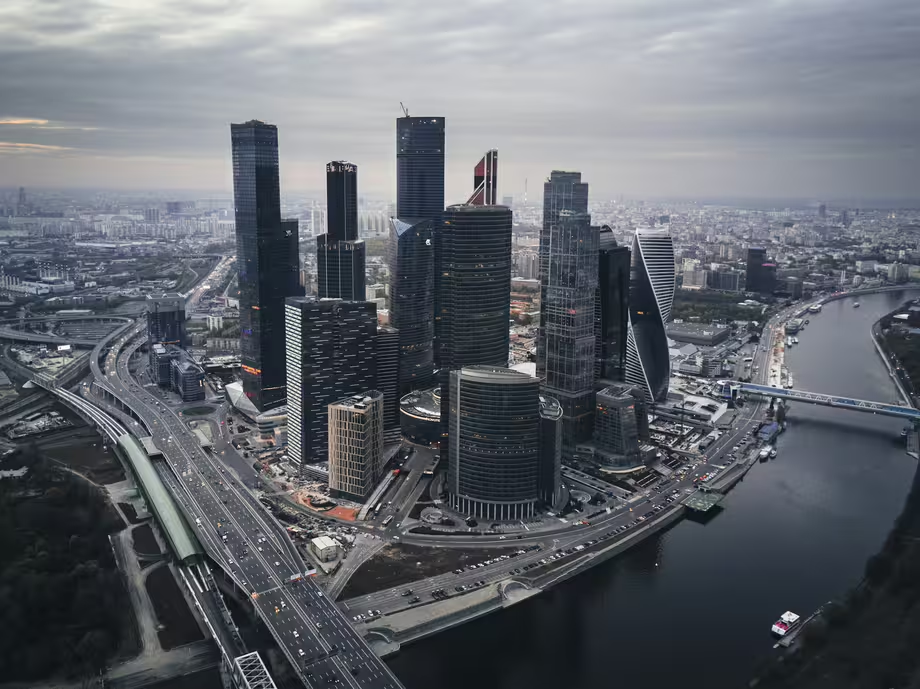
Astemir Almov / Unsplash
— Do you understand why mobile internet has disappeared in Moscow right now? Have the Kremlin’s elders come to believe that Ukraine could strike the Kremlin just as it recently struck a plant in Bryansk? Are they afraid of a Venezuela-like abduction of the president, or are they installing something new for which they needed to shut down the internet? Recall that when Ust-Luga was first hit in Leningrad Region, mobile internet for the first time was cut in neighboring Pskov Region – the reason being that military jammers were being installed on cell towers…
— First, Bryansk happened later – after mobile internet shutdowns had already begun in Russia. Storm Shadow [cruise missile] strikes on the Bryansk plant are not the cause.
Nor are drones heading toward Moscow the cause, because in recent days there have been no recorded drone attacks on the capital.
I am inclined to assume that this is all connected to Iran – to what the US and Israel are doing there. Everything going on in Iran is about hacking infrastructure that is supposed to monitor the population but instead is being used to help eliminate state leaders.
We know that Israeli intelligence gained access to surveillance cameras in Tehran. This is why the Kremlin is now combing through its entire IT infrastructure, trying to understand where vulnerabilities may lie and how tracking of Putin’s movements, his motorcades and everything else could be carried out through the very infrastructure they themselves built in Moscow to monitor the population.
Why else do I lean toward this theory? Because neither Roskomnadzor nor even air defense command could impose something like this on Moscow. This is the level of the presidential security service. Only that level can impose such sweeping restrictions on all Muscovites and inconvenience them so much.
We are talking about the Presidential Security Service within the Federal Protective Service (FSO) – the entity once headed by [Alexander] Korzhakov under Yeltsin. It is not part of the FSB – it is more powerful than the FSB. I think even the FSB would not have dared to leave all of Moscow without internet.
Clearly something came up when they identified these vulnerabilities. They clearly do not understand how to eliminate them without breaking everything they themselves rely on.
— Still, who exactly is affected?
— Everything that can be described as internet-based business. Everything tied to services that depend on geolocation, on-the-go content consumption. For them, this is simply a catastrophe. They are already barely staying afloat, with negative or near-zero profitability.
When your service is unavailable, people stop paying for it, they do not renew subscriptions. Why renew a subscription if I cannot watch a series on my commute in the metro? This could amount to billions in lost revenue, because Moscow is a huge city – plus the broader metropolitan area. Then there are taxis, car-sharing, courier services, online platforms. That is the first layer.
The second layer is nominally offline businesses for which the online component is critical. For example, you advertise through Google or Yandex Maps. You capture passing traffic and show ads to it. Someone sees your ad and goes to your shop or café. That traffic is now falling. You start losing money because people do not see you.
Marketing is 80% digital. If people with phones or tablets cannot see your communications, do not interact with them, you lose money. That is how it works.
For large enterprises, such as the Moskvich (AZLK) plant, the absence of mobile internet is unlikely to create serious problems. They already have plenty of them, however. They have just canceled production of their flagship Moskvich 5 crossover project. Everything there is falling apart, and soon the plant will have to be shuttered entirely. Things are bad there even without mobile internet disruptions.
Banking is affected, too. Payment terminals outside of bank branches have seen a sharp decline. They are just dead metal boxes now. You can conduct transactions at a bank branch with a fiber optic connection, that is fine. But you lose, say, 30-40% of card transactions – cash deposits, cash withdrawals, payment processing.
— First, Bryansk happened later – after mobile internet shutdowns had already begun in Russia. Storm Shadow [cruise missile] strikes on the Bryansk plant are not the cause.
Nor are drones heading toward Moscow the cause, because in recent days there have been no recorded drone attacks on the capital.
I am inclined to assume that this is all connected to Iran – to what the US and Israel are doing there. Everything going on in Iran is about hacking infrastructure that is supposed to monitor the population but instead is being used to help eliminate state leaders.
We know that Israeli intelligence gained access to surveillance cameras in Tehran. This is why the Kremlin is now combing through its entire IT infrastructure, trying to understand where vulnerabilities may lie and how tracking of Putin’s movements, his motorcades and everything else could be carried out through the very infrastructure they themselves built in Moscow to monitor the population.
Why else do I lean toward this theory? Because neither Roskomnadzor nor even air defense command could impose something like this on Moscow. This is the level of the presidential security service. Only that level can impose such sweeping restrictions on all Muscovites and inconvenience them so much.
We are talking about the Presidential Security Service within the Federal Protective Service (FSO) – the entity once headed by [Alexander] Korzhakov under Yeltsin. It is not part of the FSB – it is more powerful than the FSB. I think even the FSB would not have dared to leave all of Moscow without internet.
Clearly something came up when they identified these vulnerabilities. They clearly do not understand how to eliminate them without breaking everything they themselves rely on.
— Still, who exactly is affected?
— Everything that can be described as internet-based business. Everything tied to services that depend on geolocation, on-the-go content consumption. For them, this is simply a catastrophe. They are already barely staying afloat, with negative or near-zero profitability.
When your service is unavailable, people stop paying for it, they do not renew subscriptions. Why renew a subscription if I cannot watch a series on my commute in the metro? This could amount to billions in lost revenue, because Moscow is a huge city – plus the broader metropolitan area. Then there are taxis, car-sharing, courier services, online platforms. That is the first layer.
The second layer is nominally offline businesses for which the online component is critical. For example, you advertise through Google or Yandex Maps. You capture passing traffic and show ads to it. Someone sees your ad and goes to your shop or café. That traffic is now falling. You start losing money because people do not see you.
Marketing is 80% digital. If people with phones or tablets cannot see your communications, do not interact with them, you lose money. That is how it works.
For large enterprises, such as the Moskvich (AZLK) plant, the absence of mobile internet is unlikely to create serious problems. They already have plenty of them, however. They have just canceled production of their flagship Moskvich 5 crossover project. Everything there is falling apart, and soon the plant will have to be shuttered entirely. Things are bad there even without mobile internet disruptions.
Banking is affected, too. Payment terminals outside of bank branches have seen a sharp decline. They are just dead metal boxes now. You can conduct transactions at a bank branch with a fiber optic connection, that is fine. But you lose, say, 30-40% of card transactions – cash deposits, cash withdrawals, payment processing.
Share this article
Read More